
IECC 2021 Whole-Building Energy Monitoring: Electric, Gas, Water, Steam
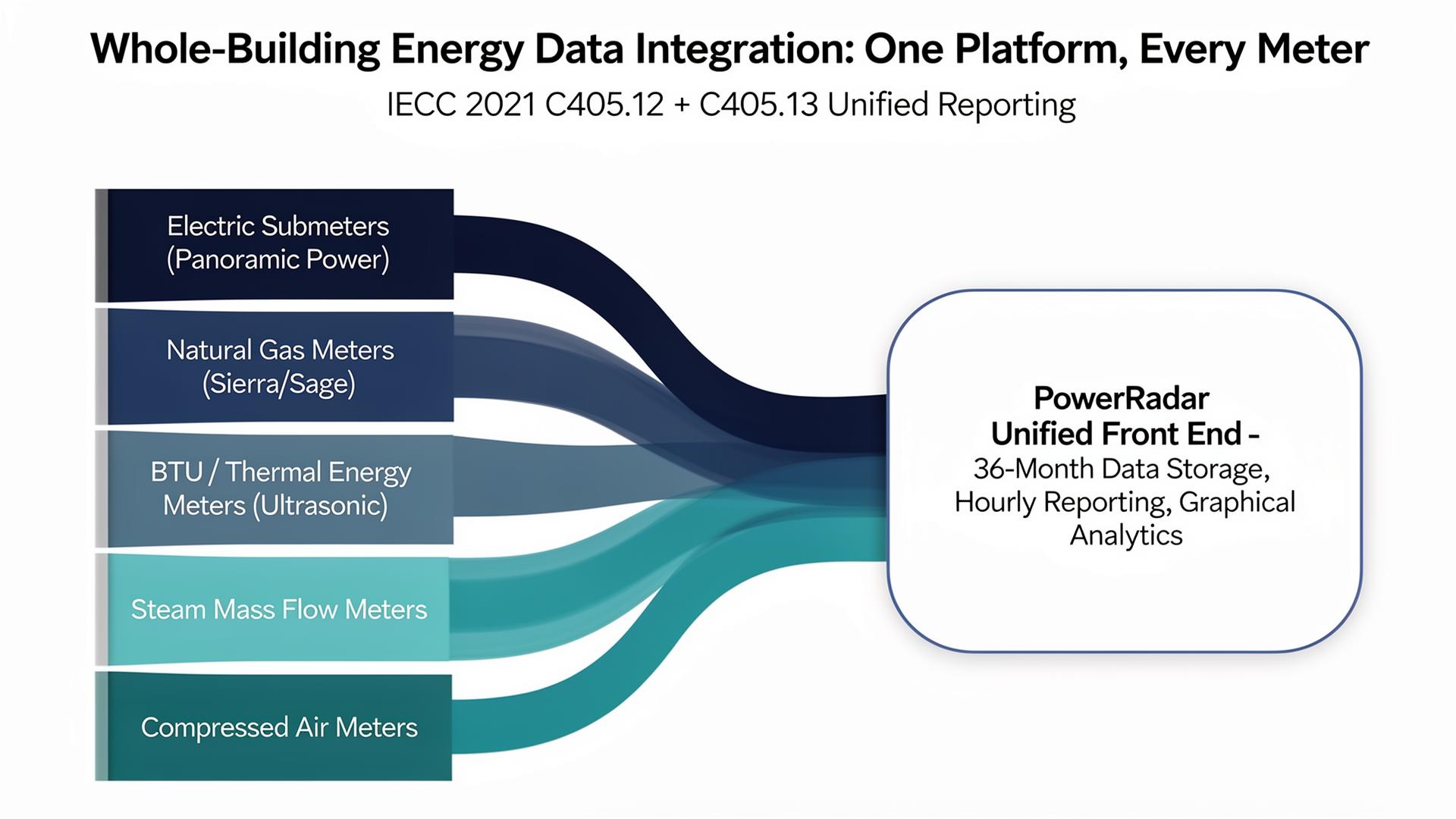
Most conversations about IECC 2021 metering focus on electrical submetering. But the code also requires monitoring of all nonelectrical energy supplied to the building — natural gas, chilled water, hot water, and steam. This guide covers Sections C405.12 and C405.13, the metering equipment needed for each energy type, and how Emergent's PowerRadar serves as the single unified front end.
The Full Scope of C405.12 and C405.13
The 2021 IECC addresses energy monitoring in two parallel sections. Section C405.12 covers electrical end-use submetering of HVAC, lighting, plug loads, and process loads. Section C405.13 extends the same monitoring principles to every nonelectrical energy source — natural gas, thermal energy through chilled water and hot water, district or on-site steam, and any other nonelectrical source.
Data acquisition requirements for nonelectrical energy mirror those for electrical: 36-month storage, hourly/daily/monthly/annual logged data, and a permanent graphical reporting mechanism. For natural gas, the system must either accept interval data from submeters or allow manual entry of utility bills. Equipment serving an individual dwelling unit, fire pumps, stairwell pressurization fans, and emergency-only systems are exempt. Tenant spaces under 2,500 sq ft with dedicated source meters are exempt as well.
States Where Whole-Building Monitoring Applies
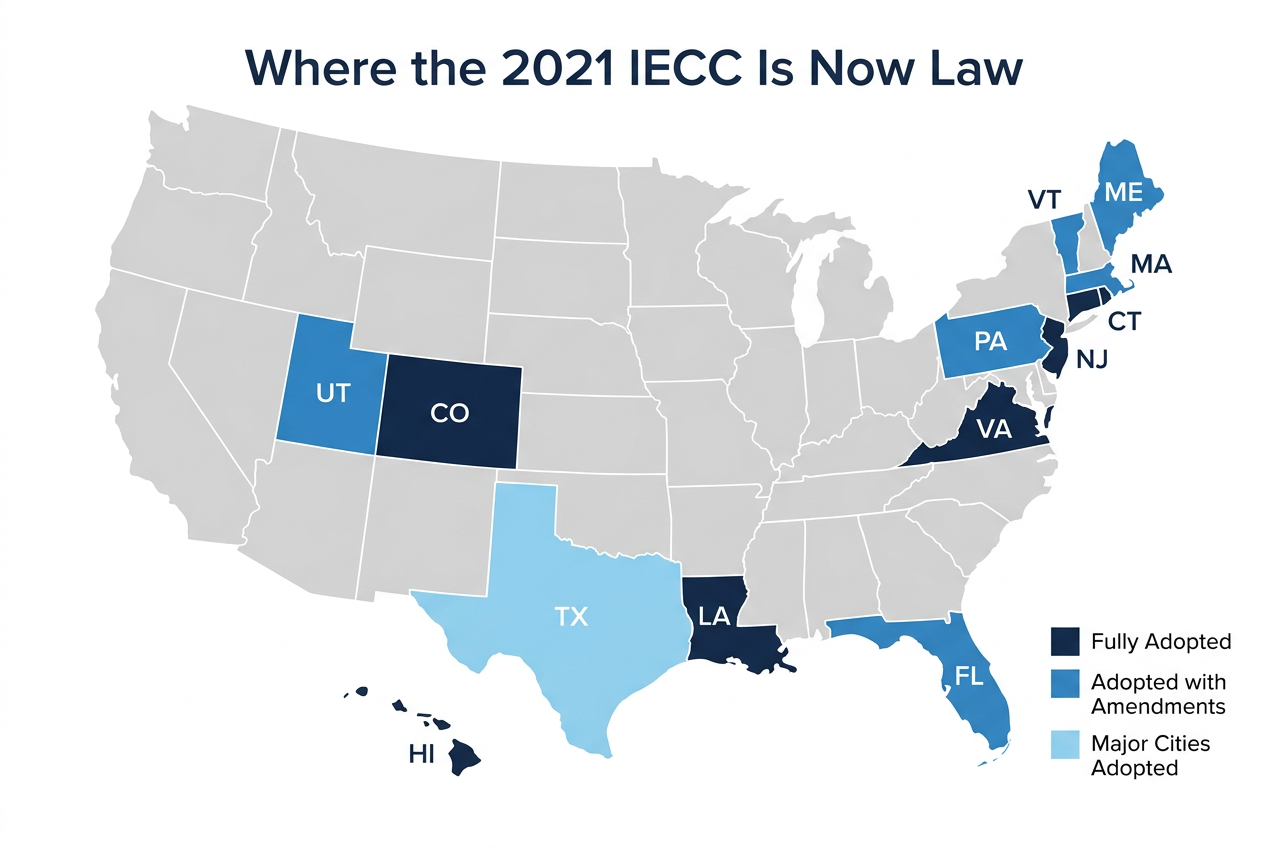
Every state on the 2021 IECC for commercial buildings triggers both C405.12 and C405.13: Connecticut, New Jersey, Hawaii, Virginia, Louisiana, Colorado, Massachusetts, Vermont, Maine, Utah, Florida (8th Edition), Pennsylvania — plus major Texas cities (Austin, Dallas, Houston, San Antonio, El Paso, Killeen).
Colorado requires the 2021 IECC as a minimum and adds electric-ready and solar-ready provisions; after July 1, 2026, any updating jurisdiction must adopt the Low Energy and Carbon Code based on the 2024 IECC. California Title 24 Part 6 mandates Energy Data Display Systems with HVAC, lighting, receptacle, process, and EV charging disaggregation at 15-minute intervals — functionally equivalent to and often more stringent than the IECC.
Metering Each Energy Type
Natural Gas
The code requires gas metering at the end-use level — boiler gas separate from kitchen gas, not just total. Emergent carries:
- Sierra Instruments BoilerTrak 620S — Thermal mass flow meter for boiler fuel gas, no moving parts, no pressure drop
- Sage Metering Model 51 — Thermal mass insertion meter for larger gas mains and process applications
Both provide pulse output and analog 4–20 mA. Pulse output connects to the Obvius/Leviton AcquiSuite A8911-23 High Density Pulse Module (up to 23 inputs) or the Gen 4+ Bridge's pulse interface. Once connected, gas data appears in PowerRadar alongside electrical data — same dashboards, same reports, same archive. Users configure the pulse scaling factor (CF or therms per pulse) and the platform handles the conversion.
Chilled Water and Heating Water (BTU)
BTU metering captures volumetric flow rate and the supply-return temperature differential simultaneously, then computes thermal energy from flow × ΔT × specific heat.
- EES-301 Ultrasonic BTU Meter ($3,000–$3,100) — Clamp-on transducers for pipes from 1″ to 48″. No cutting, no shutdown. Clamp-on temperature sensors through the pipe wall (insertion sensors available for PVC).
- EES-401 Ultrasonic BTU Meter ($3,450–$3,550) — Higher precision for billing-grade applications like district energy or tenant chilled water allocation.
Both provide Modbus RTU output for AcquiSuite hubs, JACE controllers, or the Gen 4+ Bridge. Data flows into PowerRadar as thermal energy (BTU, ton-hours, or kWh-thermal). Multiple BTU meters can disaggregate primary/secondary loops, AHU coils, or tenant distribution into PowerRadar device groups like "HVAC Heating," "HVAC Cooling," "Domestic Hot Water," and "Process Heating."
Steam
Buildings on district steam (NYC, Philadelphia, Boston, Hartford) or on-site boilers need steam mass flow metering. The Sage Metering Model 51 Thermal Mass Insertion Meter ($3,500) uses a heated sensor element to directly measure mass flow for both saturated and superheated steam — no separate pressure/temperature compensation. Insertion design installs via hot tap, no pipe cutting.
Domestic Water
- EES-101 Ultrasonic Sub-Meter ($2,600–$2,800) — Clamp-on for 1″–48″ pipes
- EES-201 High-Precision Sub-Meter ($2,980–$3,080) — Billing-grade for tenant water billing or irrigation
For smaller pipes, in-line meters from Master Meter and M&E. All integrate via pulse output.
Compressed Air
Compressed air leaks waste an estimated 20–30 percent of compressor output in typical facilities. The 2021 IECC categorizes compressed air as a process load. Emergent carries flow meters from VP Instruments (VPFlowScope, $2,000–$3,500), IFM (SD series, $1,200–$1,400), and Keyence (FD-G ultrasonic, $1,500–$5,000) — measuring CFM/SCFM, pressure, and temperature for leak detection.
The Unified Front End
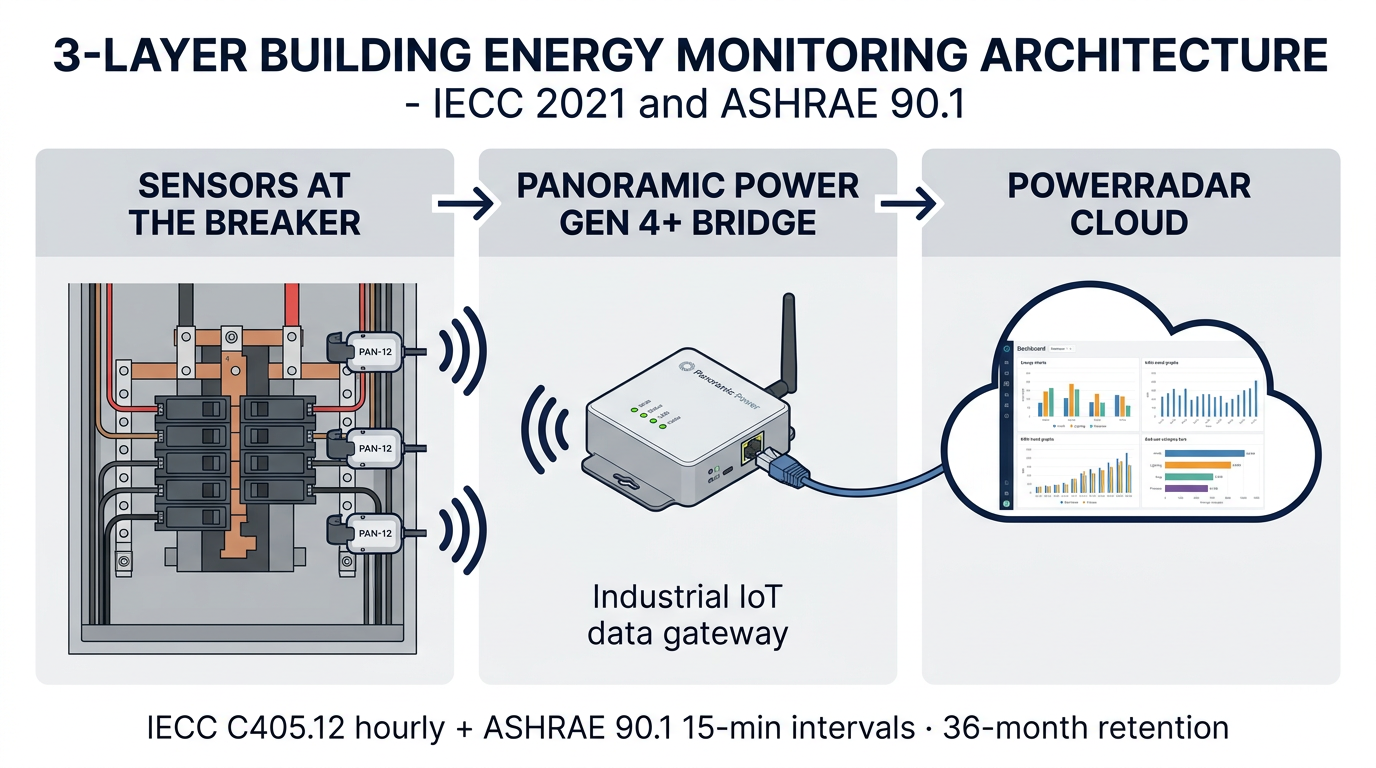
The most important practical requirement of the 2021 IECC's monitoring mandate: all energy data — electric, gas, water, steam, thermal — must be accessible through a single permanent reporting mechanism within the building.
PowerRadar serves as that unified front end. Electric subcircuit data from Panoramic Power and Leviton S7100 BCMs arrives via the Gen 4+ Bridge. Nonelectrical data from gas meters, BTU meters, steam meters, water meters, and compressed air meters arrives through Modbus to the bridge or through Obvius/Leviton AcquiSuite hubs. All data stored 36+ months with the hourly/daily/monthly/annual graphical reporting the code requires.
PowerRadar's Energy Flow (Sankey) ties the picture together: total building energy enters from the left, splits into electrical and nonelectrical streams, divides into end-use categories, and flows down to individual equipment. A building operator can glance at the diagram and immediately see where energy is consumed and where the largest savings opportunities exist.
For multi-property owners, the account dashboard provides portfolio-level views with energy intensity benchmarking and drill-down to subcircuit detail. Automated reports schedule weekly or monthly delivery to ownership, property management, and engineering teams without manual effort.
Need a whole-building metering specification covering every energy type? Contact our engineering team or call 215-645-7141 to map your building's complete energy systems to a unified monitoring solution.
Related Energy Intelligence Posts
The Hidden 30%: Where Your Building Is Bleeding Energy (And How to Find It)
Mar 4, 2026 · 6 min read
Continuous Improvement in Manufacturing: Leveraging Metering, Sensors, and Automation for Operational Excellence
Mar 1, 2026
Preventative Maintenance in Manufacturing: How Utility Metering and Sensor Data Eliminate Unplanned Downtime
Mar 1, 2026
About Emergent Metering Solutions
Emergent Metering Solutions provides commercial and industrial metering hardware, installation support, and energy analytics services. We specialize in electric meters, water meters, BTU meters, compressed air meters, gas meters, and steam meters with Modbus RTU, BACnet IP, pulse output, and wireless communication options. Our Managed Intelligence services deliver automated reporting, anomaly detection, tenant billing, and AI-powered consumption forecasting. We support compliance with IECC 2021, ASHRAE 90.1-2022, NYC Local Law 97, Boston BERDO 2.0, DC BEPS, California LCFS, and EU CSRD requirements.
Contact our engineering team for meter selection guidance, system design, and project quotes.