ASHRAE 90.1-2019 vs. 90.1-2022: Metering Requirements Compared
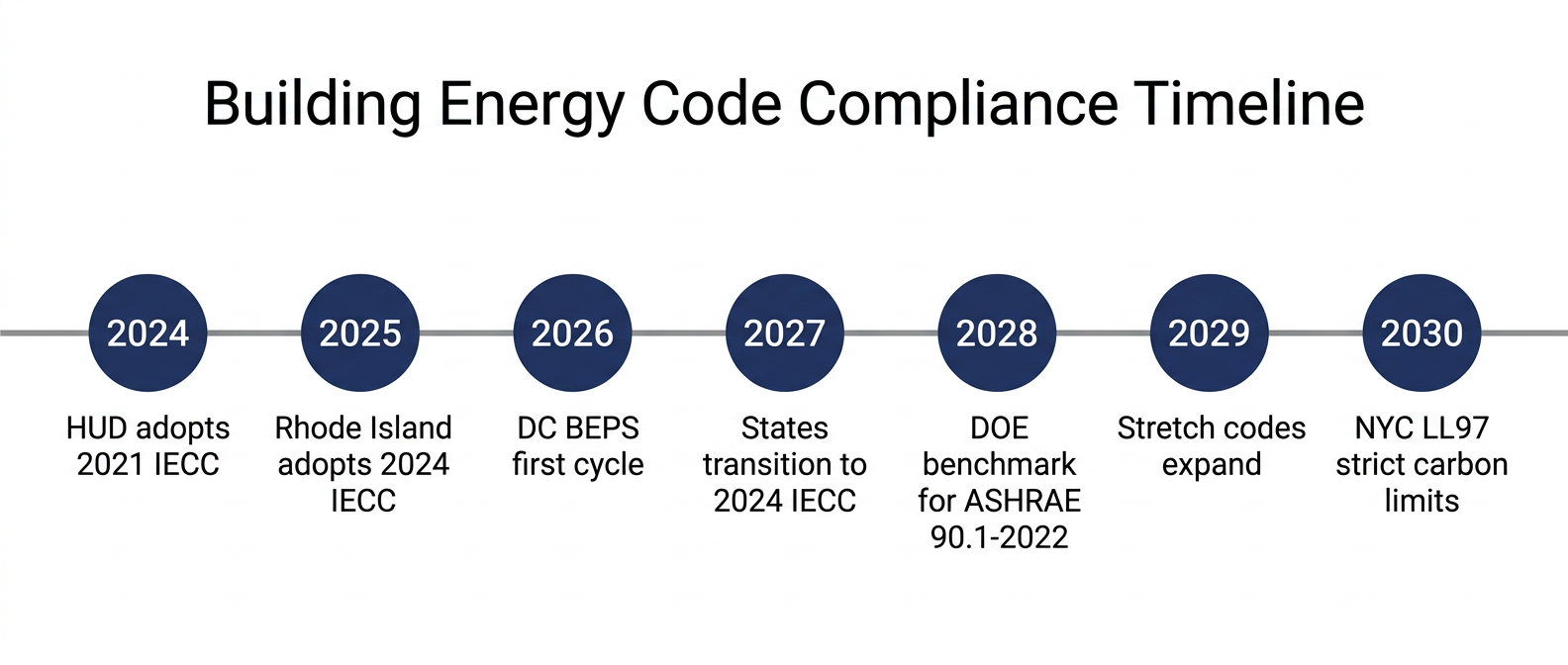
ASHRAE 90.1 has required energy metering in commercial buildings for years — but the jump from the 2019 to the 2022 edition dramatically expanded what must be monitored, how granularly, and in which buildings. Here is what design teams and building owners need to understand, including a detailed look at how subcircuit-level wireless monitoring and the unified PowerRadar front end deliver compliance from design through operations.
The Evolution of Section 8.4.3
ASHRAE 90.1-2016 introduced chilled-water plant metering and elevator efficiency provisions, and added Appendix G as a stable baseline that allows buildings from any code version to be compared.
ASHRAE 90.1-2019 took a substantial leap forward. It introduced formal commissioning for projects over 10,000 sq ft, mandated independent commissioning providers, required either inspected air barriers or a whole-building blower door test, and dropped lighting power densities ~20 percent (assuming all-LED). Most importantly for metering, 90.1-2019 established that electricity meters must record both consumption (kWh) and demand (kW), that whole-building electricity meters must record power factor, and that all metering data must be recorded at minimum 15-minute intervals and retained for at least 36 months with remote accessibility.
ASHRAE 90.1-2022 expanded the standard's scope beyond the building itself to include sites — parking lot lighting not connected to the building electrical service, EV charging stations, and on-site PV equipment. Section 8.4.3 now requires monitoring in all buildings and additions over 25,000 sq ft with separate monitoring for whole-building consumption, HVAC, interior lighting, exterior lighting, and receptacle circuits. The new Section 11 Energy Credits system makes comprehensive monitoring one of the most straightforward credits to earn. The 2022 edition also introduced minimum on-site renewable energy and a new Total System Performance Ratio (TSPR) compliance path for HVAC.
Where These Standards Are Currently in Effect
- New Jersey — Adopted 90.1-2019 without amendments (Sept 2022)
- Virginia — 90.1-2019 incorporated, effective Jan 2024 (permits dated 1/18/2025+)
- Michigan — Moving from 90.1-2013 directly to 90.1-2019
- Connecticut — 2021 IECC (which references 90.1-2019), Oct 2022; drafting 2024 IECC adoption
- Rhode Island — First Northeast state on a 2024 IECC-based code (which references 90.1-2022), effective Dec 1, 2025
- Colorado — 2021 IECC minimum 2023–2026; Low Energy and Carbon Code (2024 IECC) required after July 2026
- Federal Buildings — DOE benchmark: states should adopt 90.1-2022 by Jan 1, 2028
States currently on 90.1-2019 will move to 90.1-2022 within two to three years. Engineers who design to 90.1-2022 today save their clients from costly retrofits.
What Subcircuit Monitoring Means for ASHRAE Compliance
Both editions require separate monitoring of energy consumption by end-use category. This cannot be accomplished with a single whole-building meter. It requires subcircuit monitoring — sensors on individual circuits that serve specific equipment types, aggregated into the required end-use categories with no more than 5% cross-category contamination.
How the Panoramic Power Wireless Sensors Solve It
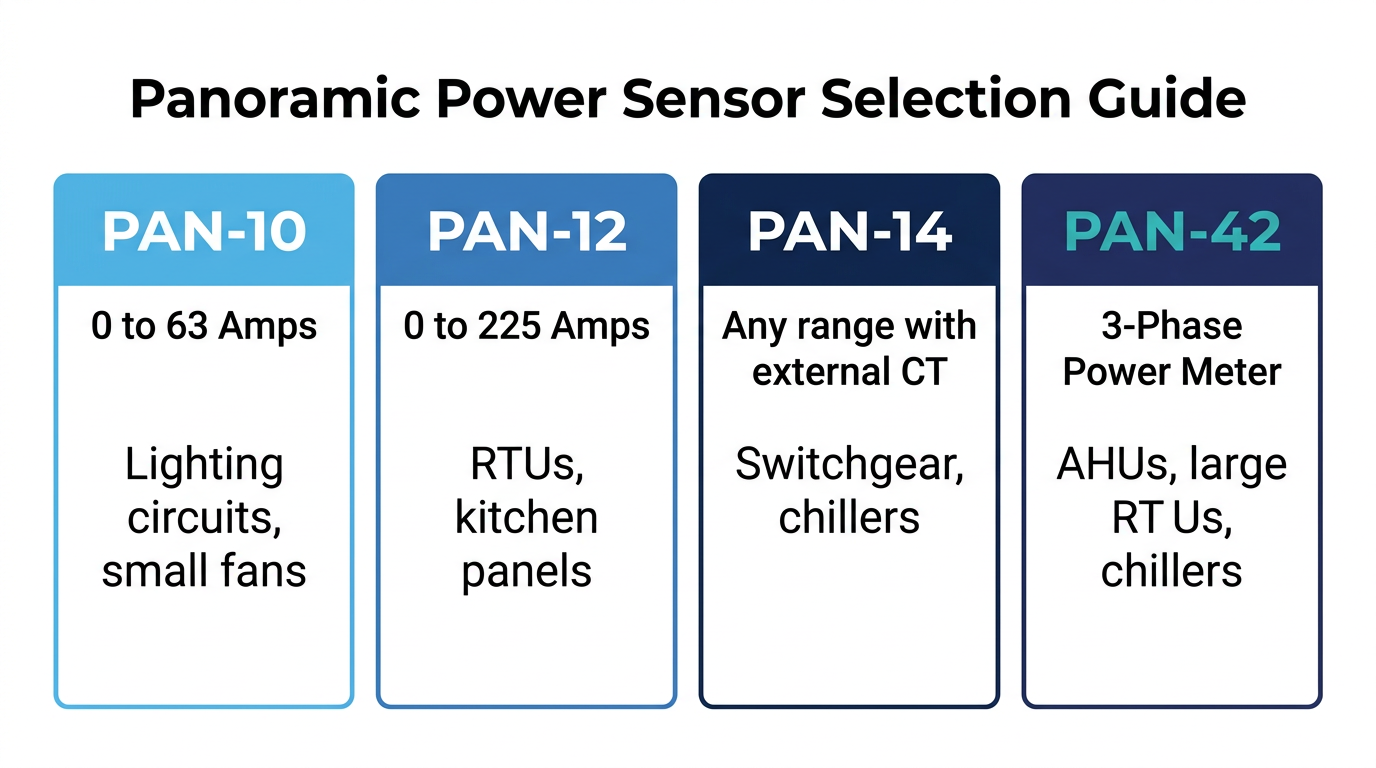
Because each Panoramic Power sensor is self-powered, wireless, and matchbox-sized, sensors install on individual breakers inside any panel without disrupting building operations. No de-energization, no signal wiring, no external power. An electrician can install hundreds of sensors across a building in a single day.
Each sensor is registered with its unique ID and mapped to a device — RTU-1, AHU-2, Lighting Panel LP-1, Receptacle Panel RP-3, Kitchen Hood Exhaust, Elevator Machine Room. Device Groups in PowerRadar then aggregate those devices into ASHRAE end-use categories: RTU-1, AHU-2, Chiller-1, and pump circuits become "Total HVAC"; LP-1, LP-2, LP-3 become "Interior Lighting." If a circuit is reassigned during a tenant improvement, the sensor does not move — only the device group changes.
The PAN-42 for Three-Phase HVAC Equipment
ASHRAE places special emphasis on HVAC because it typically represents 40–60 percent of a commercial building's electrical consumption. For three-phase HVAC — RTUs, chillers, cooling towers, large AHUs — the PAN-42 provides the true power measurement (kW, kVA, kVAR, PF, kWh) ASHRAE requires. Supports 4-wire Wye (277/480 V), 3-wire Delta (240/416 V), single-phase 3-wire, single-phase 2-wire, and dual-phase. Sub-minute transmission delivers the 15-minute resolution ASHRAE 90.1-2019 mandates.
Emergent's AHU Metering Package ($1,300) bundles a PAN-42, cellular Gen 4+ Bridge, and sized CTs into a single SKU — pre-tested and installable in under an hour per unit.
The Leviton S7100 BCM for Mixed Panels
For panelboards that mix end-use categories, the Leviton S7100 Branch Circuit Monitor measures energy across 12, 24, or 48 circuits via Modbus RTU to the AcquiSuite hub or directly to the bridge. The 48-input model ($3,000) fully monitors a 42-space panelboard with spare capacity.
PowerRadar as the Unified Front End for ASHRAE Compliance
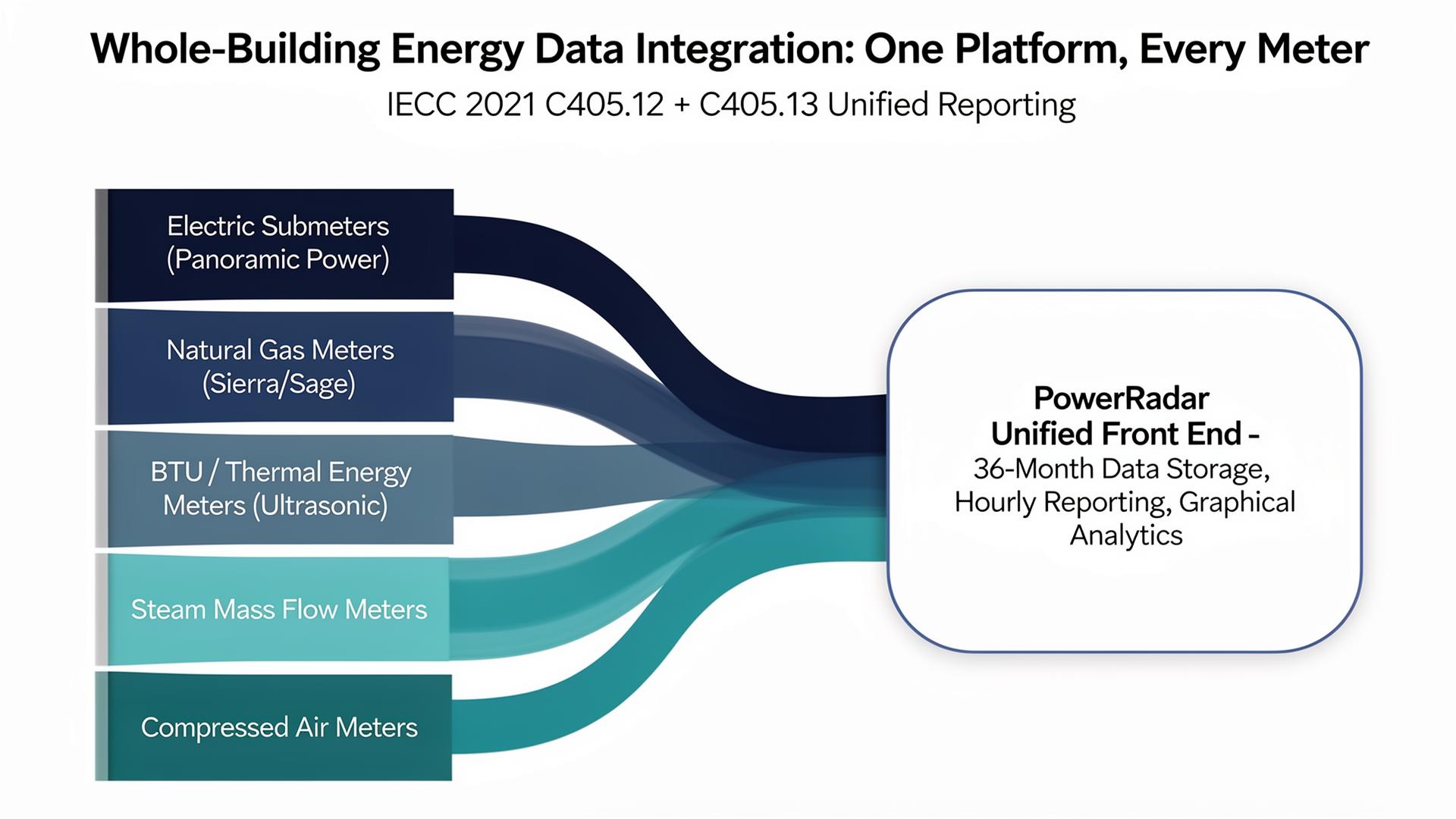
ASHRAE 90.1 requires an integrated data acquisition system that aggregates all energy data into a unified reporting interface — not five disconnected platforms. PowerRadar fills this role.
All Panoramic Power wireless sensors, Leviton S7100 BCMs, and pulse-connected third-party meters (gas, water, steam, BTU) feed into PowerRadar. Building operators see their entire energy profile in one place. The platform's automated reporting generates the graphical reports both 90.1-2019 and 90.1-2022 require, stored for the mandatory 36-month retention with remote web and mobile access.
PowerRadar's data normalization adjusts consumption for weather and site-specific parameters — particularly valuable for buildings subject to Building Performance Standards. The carbon footprint widget calculates CO2e using configurable emission factors, supporting corporate sustainability reporting alongside code compliance.
For buildings with existing BMS, the Honeywell JACE WEB-8000 / WEB-9000 controller provides Niagara Framework protocol translation that aggregates metering data with HVAC setpoints, occupancy schedules, outdoor air conditions, and control sequences. JACE data forwards to PowerRadar for unified reporting, or the JACE serves as the primary front end for buildings needing deep BMS integration.
Need help matching ASHRAE 90.1 metering to your building's electrical architecture? Call 215-645-7141 or submit a Project Intake Form. Our engineers will review your one-lines and provide a sensor-by-sensor specification with mapping and cost estimate.
Related Energy Intelligence Posts
The Hidden 30%: Where Your Building Is Bleeding Energy (And How to Find It)
Mar 4, 2026 · 6 min read
Continuous Improvement in Manufacturing: Leveraging Metering, Sensors, and Automation for Operational Excellence
Mar 1, 2026
Preventative Maintenance in Manufacturing: How Utility Metering and Sensor Data Eliminate Unplanned Downtime
Mar 1, 2026
About Emergent Metering Solutions
Emergent Metering Solutions provides commercial and industrial metering hardware, installation support, and energy analytics services. We specialize in electric meters, water meters, BTU meters, compressed air meters, gas meters, and steam meters with Modbus RTU, BACnet IP, pulse output, and wireless communication options. Our Managed Intelligence services deliver automated reporting, anomaly detection, tenant billing, and AI-powered consumption forecasting. We support compliance with IECC 2021, ASHRAE 90.1-2022, NYC Local Law 97, Boston BERDO 2.0, DC BEPS, California LCFS, and EU CSRD requirements.
Contact our engineering team for meter selection guidance, system design, and project quotes.