
Future-Proofing Buildings: 2024 IECC, IRA Funding & Building Performance Standards
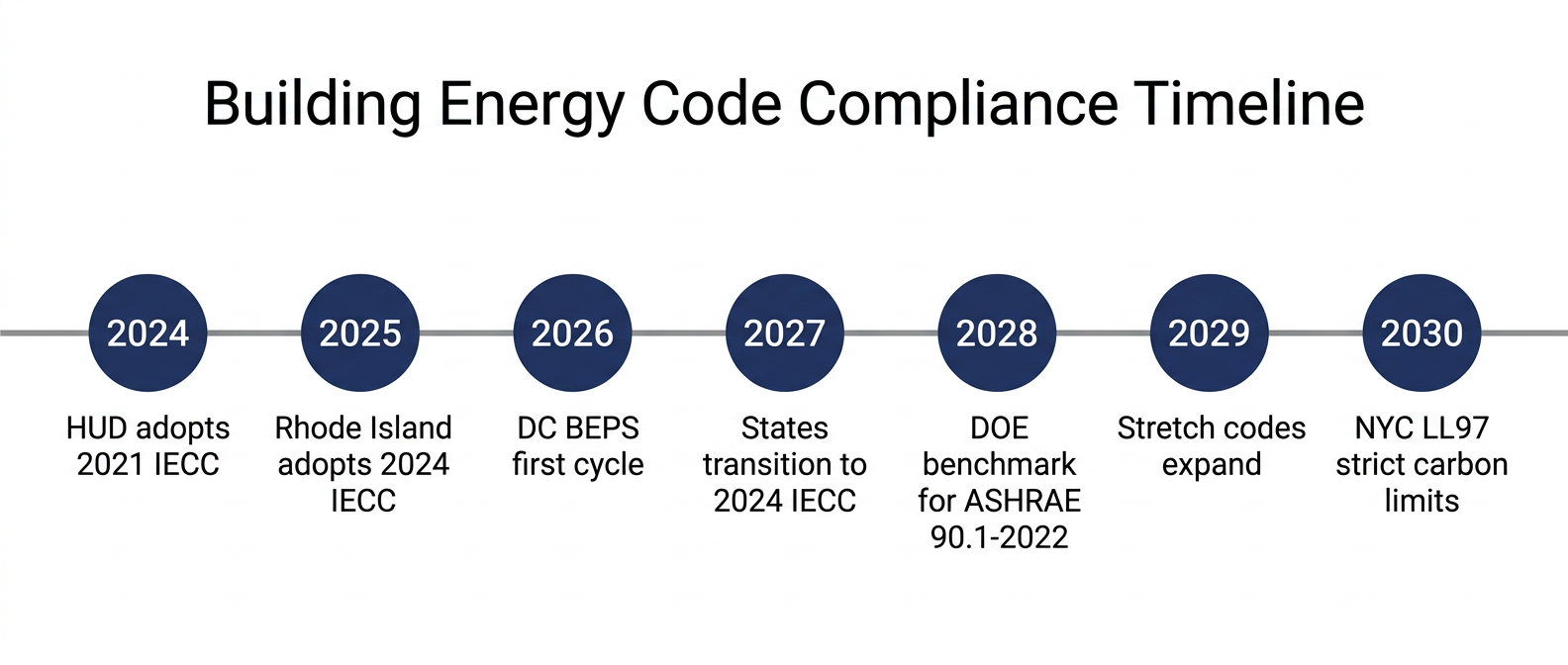
Even if your state just adopted the 2021 IECC, the next wave of energy code changes is already visible. Smart building owners are installing subcircuit monitoring infrastructure today that will satisfy not only current codes but the 2024 IECC, Inflation Reduction Act compliance, and the growing wave of Building Performance Standards. This post explains what is coming and how Emergent's modular, open-protocol approach positions your building for every foreseeable regulatory requirement.
The 2024 IECC: What's Coming and Who's Moving First
The 2024 IECC was published in July 2024 — the most aggressive energy code update in the code's history. Rhode Island became the first Northeast state with an effective 2024-IECC-based code, effective December 1, 2025, including electric-ready provisions through Appendices RK and CH.
Eight additional Northeast/Mid-Atlantic states are reviewing the 2024 IECC: Connecticut, DC, Delaware, Maine, Maryland, Massachusetts, New Jersey, and New York. Connecticut's 18-month fast-track means it could have the 2024 IECC in effect by late 2026. Massachusetts is likely to incorporate 2024 IECC elements into its next Stretch Code and Specialized Code updates. Colorado's Energy Code Board has already published the Low Energy and Carbon Code based on the 2024 IECC, which jurisdictions must adopt when updating after July 1, 2026.
The 2024 edition expands monitoring scope: it strengthens the additional efficiency credit system (Section C406), increases the required credit count, and adds credits for monitoring beyond the minimum. It introduces mandatory renewable energy provisions, meaning buildings will need to meter both consumption and on-site generation. Building envelope, HVAC efficiency, and lighting requirements are all more stringent. Buildings designed and metered to meet the 2021 IECC today should include additional sensor capacity and communication infrastructure to accommodate these expanded requirements without a costly retrofit.
Inflation Reduction Act Funding: How Metering Data Unlocks Federal Incentives
The IRA allocated $330 million in grants for states to adopt the latest building energy codes, plus an additional $670 million for stretch energy codes targeting net-zero. This billion-dollar federal investment is accelerating state adoption and pushing jurisdictions to leapfrog intermediate code versions.
The Section 179D Energy Efficient Commercial Buildings Deduction provides tax deductions of up to $5.00 per square foot for buildings achieving substantial energy savings vs. ASHRAE 90.1 baselines. Claiming the deduction requires an energy model and increasingly post-construction performance data to validate model assumptions. Buildings with comprehensive subcircuit monitoring can provide the granular consumption data needed to support 179D claims.
For organizations pursuing IRA incentives, PowerRadar's automated reporting generates the energy consumption documentation needed for federal compliance submissions. Cost Reports with tariff-based analysis show actual energy costs. Sustainability Reports calculate carbon emissions using configurable CO2e factors. Benchmarking against ASHRAE baselines demonstrates savings. All reports are time-stamped, stored in the cloud, and exportable.
Building Performance Standards: The Compliance Driver That Never Expires
Building codes apply at construction. Building Performance Standards (BPS) are fundamentally different — they apply to existing buildings on an ongoing basis, requiring continuous reporting and improvement. The metering infrastructure installed during construction must continue operating for the life of the building.
- NYC Local Law 97 — Buildings >25,000 sq ft must meet progressively tightening carbon emission limits through 2050, with penalties of $268 per metric ton of CO2e over the limit
- Washington DC BEPS — Existing buildings >10,000 sq ft must meet performance targets verified through ENERGY STAR Portfolio Manager
- Boston BERDO 2.0, Seattle, Denver, St. Louis, Montgomery County (MD) — Enacted or developing their own BPS laws
The common requirement is granular energy data. You cannot calculate carbon emissions, benchmark against peers, or demonstrate year-over-year improvement without disaggregated end-use data and historical baselines. Building owners who install comprehensive subcircuit monitoring at construction — even where no BPS exists yet — gain three advantages: the data foundation is in place when a BPS arrives, energy reductions can begin immediately through operational insights, and energy performance can be reported proactively to tenants and investors.
Designing a Future-Proof Subcircuit Monitoring Infrastructure
A future-proof strategy starts with installing more capacity than the current code requires. If your jurisdiction mandates five end-use categories, design for seven or eight — including renewables, EV charging, tenant-level disaggregation, and backup generator fuel. The incremental cost of a Panoramic Power sensor at $190 each is a fraction of a future retrofit.
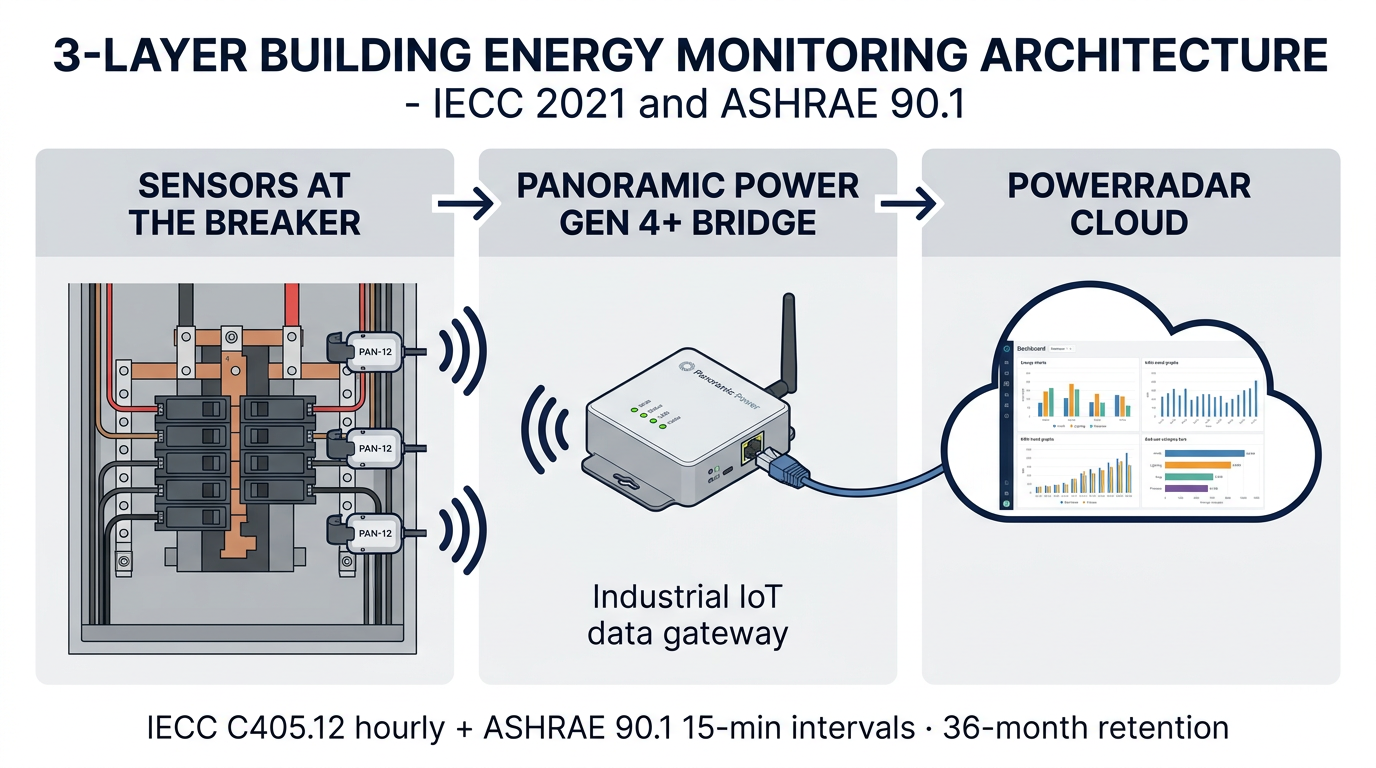
Design decisions that pay dividends:
- Install PAN-42 meters on all three-phase HVAC, not just the largest units. Smaller RTUs and split systems on PAN-10/12 today may need true power measurement under future codes. The PAN-42's $389 price point is modest vs. retrofitting later.
- Install sensors on circuits currently exempt. Tenant spaces under 2,500 sq ft are exempt under 2021 IECC, but future BPS laws and the 2024 IECC may lower exemptions. A PAN-10 at $190 today provides data that may be required within 5 years.
- Use the Gen 4+ Bridge's Modbus port to integrate non-electric meters from day one. Even if not yet required, connecting gas and BTU meters during construction establishes the data pipeline.
- Choose integration platforms with open protocols. Emergent's ecosystem supports Modbus RTU, Modbus TCP, BACnet, pulse, analog 4–20 mA, and LoRaWAN — meaning any future meter can integrate without replacing the data acquisition platform.
- Deploy AcquiSuite or Honeywell JACE for on-premises data redundancy. Local hubs preserve data during internet outages and provide a real-time access point without cloud latency.
- Specify Packaged Panels for mechanical rooms and remote locations. Pre-configured weatherproof enclosures dramatically reduce field labor.
Why Emergent Is the Future-Proof Choice
Open standards — Every product communicates through industry-standard protocols. Bridges expose Modbus and cloud APIs. S7100 BCMs use Modbus RTU. AcquiSuite hubs support Modbus, BACnet, and pulse. JACE controllers support virtually every building protocol through Niagara Framework drivers.
Modular scalability — No hardware or software limit on sensors per bridge, bridges per site, or sites per account. A building that starts with 50 sensors can grow to 200 next year without replacing infrastructure.
Unified front-end analytics — Every piece of data from every sensor, every meter, every energy type, every building flows into PowerRadar as a single pane of glass. Operators, facility managers, ownership groups, and engineering teams access the same platform with role-based permissions.
For renewable energy production, PAN-42 sensors meter solar PV inverter output and battery storage alongside building loads, enabling PowerRadar to display net energy usage and net-zero progress. For EV charging, PAN-10/12 sensors on Level 2 charger circuits and PAN-42 meters on DC fast charger feeds provide the separate EV metering the 2024 IECC and many municipal codes now require.
Ready to future-proof your building's energy monitoring? Start with a free Project Intake consultation or call 215-645-7141. Our engineers will review your current and anticipated regulatory requirements and design a monitoring system that satisfies every foreseeable code.
Related Energy Intelligence Posts
The Hidden 30%: Where Your Building Is Bleeding Energy (And How to Find It)
Mar 4, 2026 · 6 min read
Continuous Improvement in Manufacturing: Leveraging Metering, Sensors, and Automation for Operational Excellence
Mar 1, 2026
Preventative Maintenance in Manufacturing: How Utility Metering and Sensor Data Eliminate Unplanned Downtime
Mar 1, 2026
About Emergent Metering Solutions
Emergent Metering Solutions provides commercial and industrial metering hardware, installation support, and energy analytics services. We specialize in electric meters, water meters, BTU meters, compressed air meters, gas meters, and steam meters with Modbus RTU, BACnet IP, pulse output, and wireless communication options. Our Managed Intelligence services deliver automated reporting, anomaly detection, tenant billing, and AI-powered consumption forecasting. We support compliance with IECC 2021, ASHRAE 90.1-2022, NYC Local Law 97, Boston BERDO 2.0, DC BEPS, California LCFS, and EU CSRD requirements.
Contact our engineering team for meter selection guidance, system design, and project quotes.