
IECC 2021 Submetering Mandate: Complete Guide to Subcircuit Monitoring
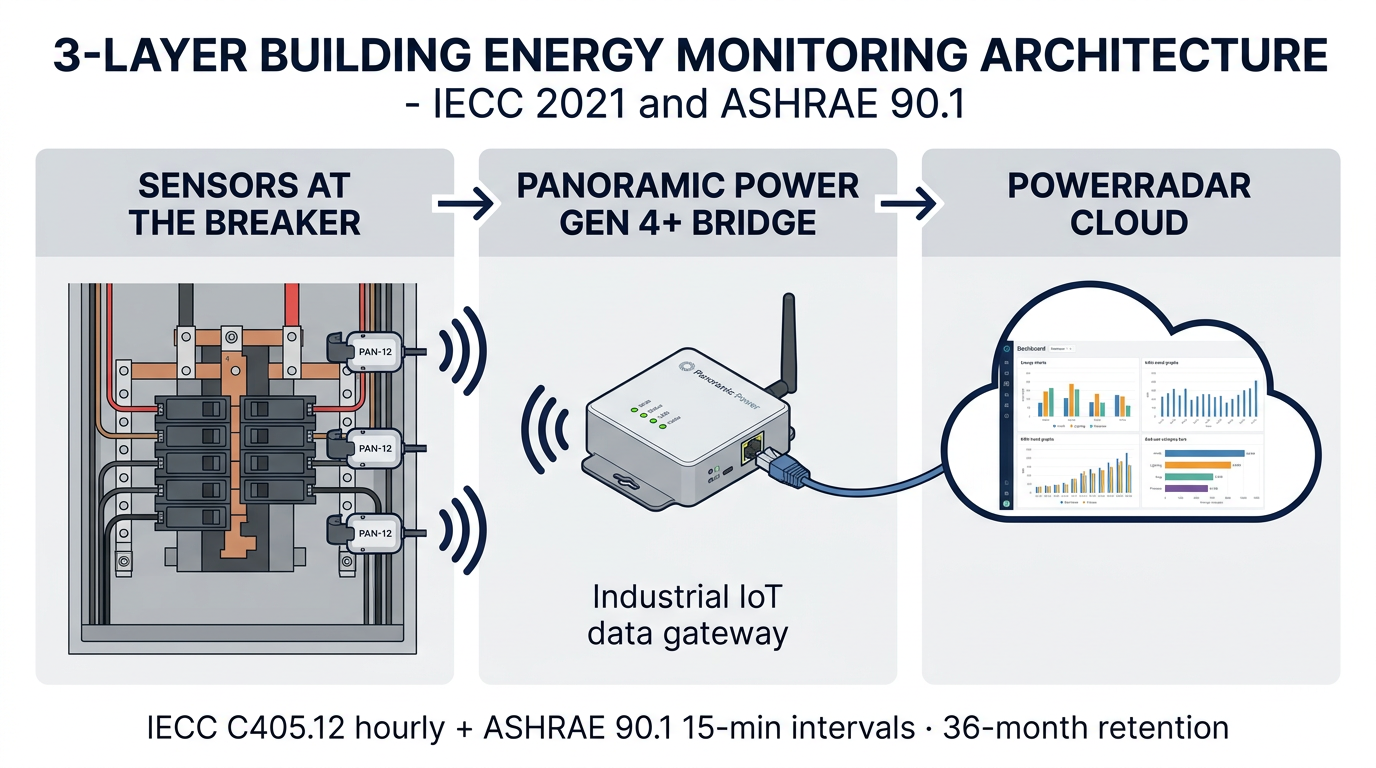
The 2021 International Energy Conservation Code introduced the most significant energy monitoring requirements in the code's history. If your state has adopted it, your next commercial project over 25,000 square feet must include end-use submetering with granular, subcircuit-level data — and the clock is ticking. This guide breaks down exactly what the code requires, how subcircuit monitoring technology works at the equipment level, and how Emergent Metering's unified PowerRadar platform ties it all together.
A Watershed Moment for Energy Metering in Commercial Buildings
For decades, commercial buildings relied on a single utility meter at the point of service entry. That meter told building owners one thing: how much total electricity they consumed each month. It revealed nothing about which systems consumed the most, when peak loads occurred, or where energy was being wasted. The 2021 IECC changed that paradigm entirely with Section C405.12, which now requires new commercial buildings and additions with a gross conditioned floor area of 25,000 square feet or more to install comprehensive energy monitoring systems that track consumption by end-use category.
This is not a suggestion, an optional credit, or a stretch-code aspiration — it is a mandatory prescriptive requirement in every jurisdiction that has adopted the 2021 IECC for commercial buildings. The code requires separate monitoring and reporting of five distinct end-use categories: total HVAC system energy, interior lighting, exterior lighting, plug loads, and process loads. All data must be stored for a minimum of 36 months and reported at least hourly through a graphical reporting interface.
Which States Are Affected Today?
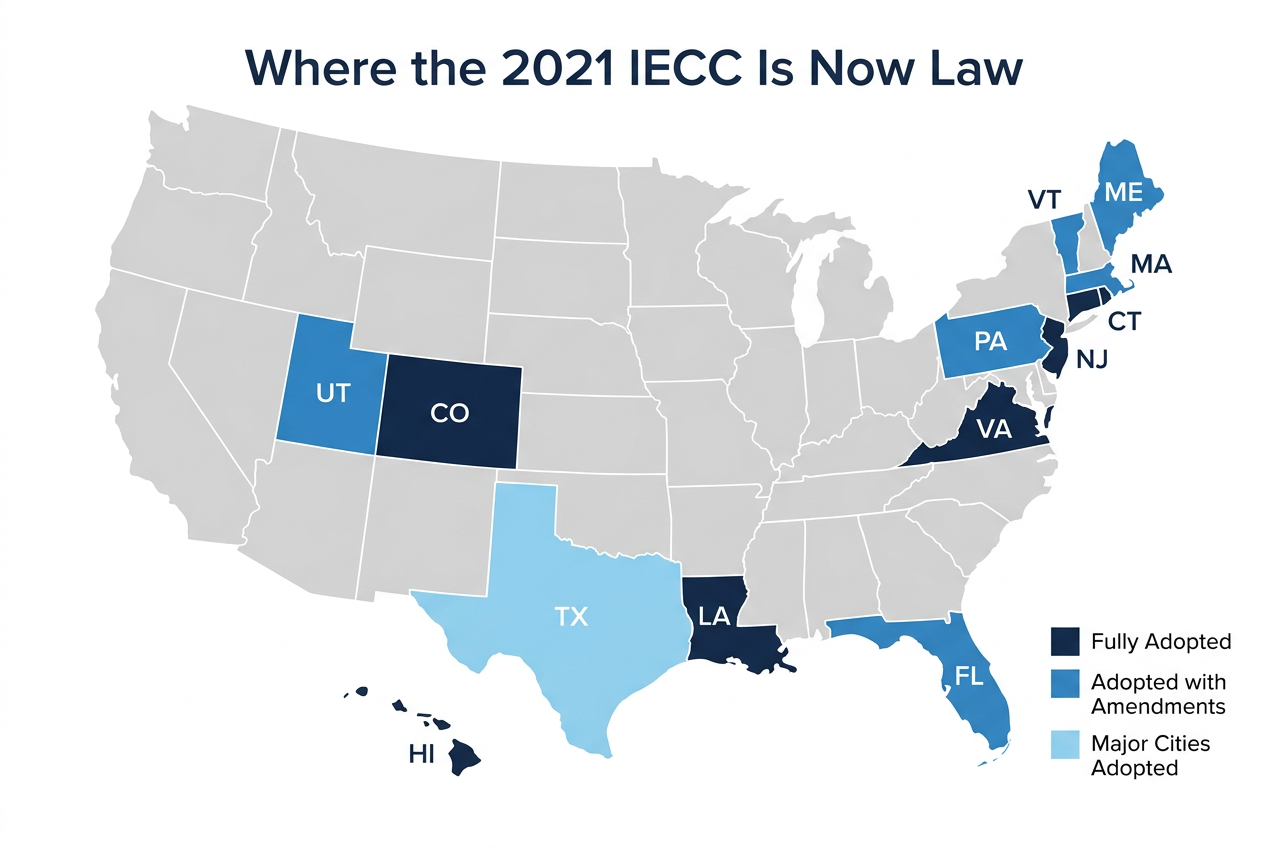
As of early 2026, the following states have adopted the 2021 IECC (or ASHRAE 90.1-2019, which contains equivalent metering mandates) for commercial buildings:
Fully Adopted 2021 IECC: Connecticut, New Jersey, Hawaii, Virginia, Louisiana, Colorado.
Adopted with Amendments: Massachusetts, Vermont, Maine, Utah, Florida (8th Edition), Pennsylvania.
Major Cities Leading: Austin, Dallas, Houston, San Antonio, Philadelphia, New York.
HUD and USDA published a Final Determination in April 2024 adopting the 2021 IECC and ASHRAE 90.1-2019 as minimum requirements for all federally financed housing programs — including FHA-insured multifamily, USDA Rural Development, and HUD-assisted construction. Texas home-rule cities (Austin, Dallas, Houston, San Antonio, El Paso, Killeen) have adopted local codes based on 2021 IECC. Colorado mandates that any municipality updating its building code between July 2023 and June 2026 adopt the 2021 IECC as a minimum.
The Technical Requirements
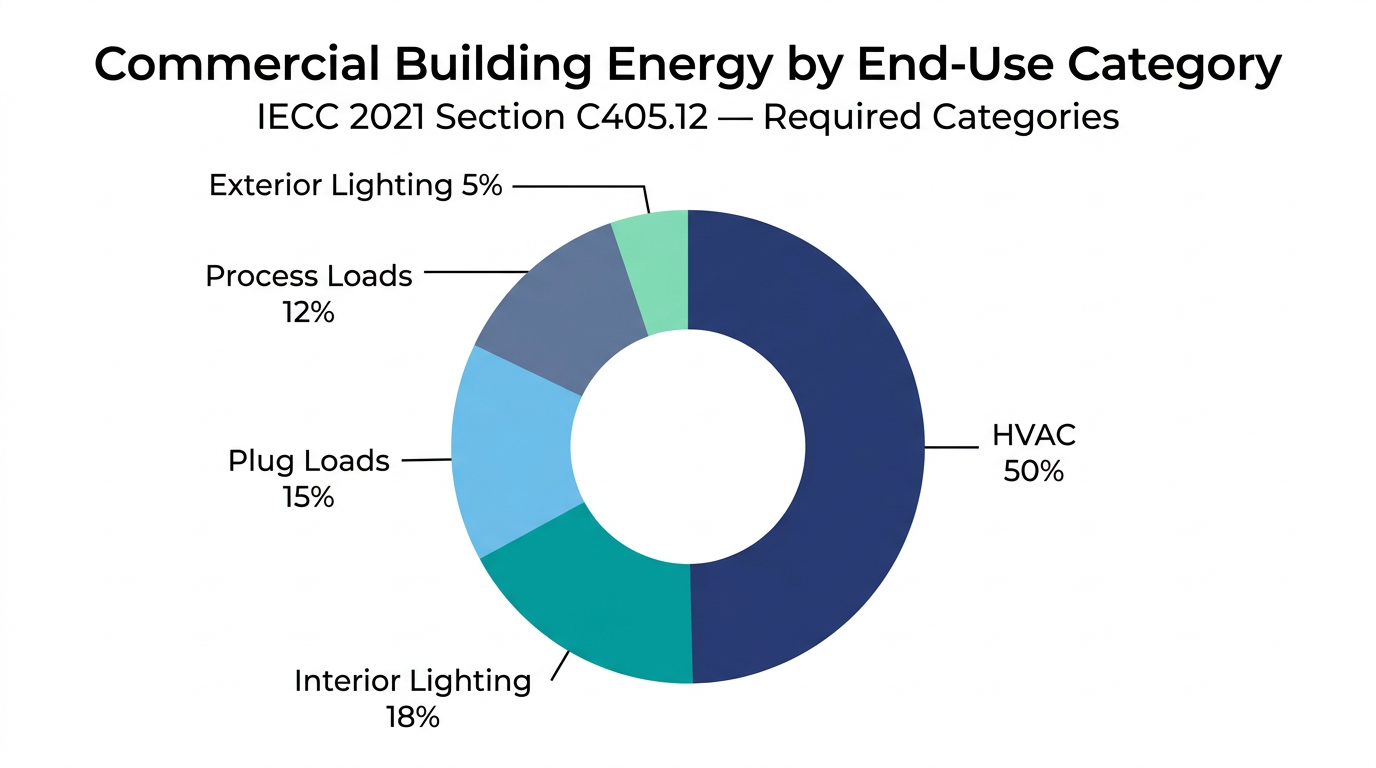
Section C405.12 specifies five end-use categories through electrical metering (C405.12.1) and end-use metering (C405.12.2):
- Total HVAC — chillers, boilers with electric controls, AHUs, RTUs, split systems, VRF, exhaust fans, pumps
- Interior Lighting — general, task, accent, and emergency lighting that also serves normal operations
- Exterior Lighting — parking lot, pathway, facade, and signage lighting
- Plug Loads — workstation equipment, kitchen appliances, vending, miscellaneous receptacle loads
- Process Loads — elevators, escalators, data center equipment, commercial cooking, laundry
Meters must have a tested accuracy of ±2 percent. Not more than 5 percent of the measured load for each end-use category may come from a load that does not belong to that category. Data must be stored for 36 months with hourly, daily, monthly, and yearly logged values, and a permanent graphical reporting mechanism must be installed in the building.
Exceptions: R-2 occupancies (apartments), tenant spaces under 5,000 sq ft with their own utility meters, and tenant spaces under 2,500 sq ft with dedicated source meters. Submetering is not required for fire pumps, stairwell pressurization fans, or emergency-only systems.
How Subcircuit Monitoring Actually Works
Layer 1: Sensors at the Circuit Breaker
Emergent's primary platform is the Panoramic Power wireless sensor family. Each sensor clamps directly onto the insulated conductor coming out of the circuit breaker, harvests its power from the magnetic field around that wire, and transmits data wirelessly at 915 MHz every 10 seconds. No batteries, no signal wires, no external power.
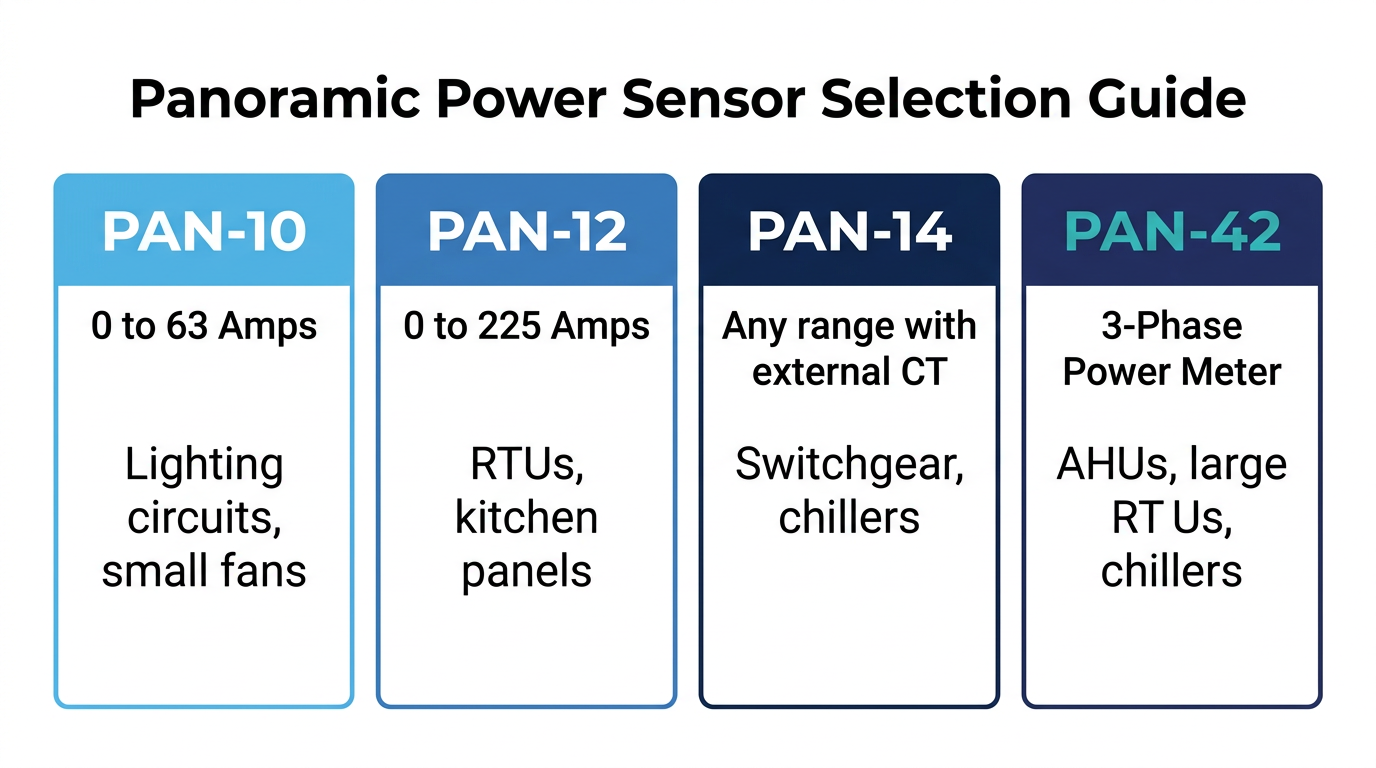
- PAN-10 (0–63 A) — Small single-phase circuits, max wire OD 7 mm. Lighting circuits, small receptacle panels, exhaust fans under 5 HP. $190.
- PAN-12 (0–225 A) — Medium circuits, max wire OD 18.8 mm. Larger lighting panels, medium RTUs, small chillers, DHW heaters. $190.
- PAN-14 (any range) — High-current sensor that pairs with any 0–5 A secondary CT. Main switchgear, large motors, chiller compressors. $190 sensor + CTs from $40 to $300.
- PAN-42 (3-phase power meter) — True kW, kVAR, kVA, PF, kWh across all three phases. Supports 4-wire Wye, 3-wire Delta, single-phase, and dual-phase at 120/208, 240/416, or 277/480 V. $389.
Layer 2: The Gen 4+ Bridge
The bridge receives the 915 MHz transmissions from every sensor in range and securely transmits aggregated data to the PowerRadar cloud. Available in LAN ($370), WiFi, and 4G LTE cellular ($470) configurations. Tri-carrier 4G SIMs ($150/yr) work with Verizon, AT&T, and T-Mobile. The bridge also features an RS-485 Modbus port that integrates external gas meters, water meters, BTU meters, and steam meters into the same data stream.
Layer 3: PowerRadar — The Unified Front End
PowerRadar stores all data for 36+ months and provides the hourly, daily, monthly, and annual graphical reports that the 2021 IECC mandates. Key features:
- Site Dashboard — Real-time kW with sensor and bridge status, plus local temperature for weather context
- Time View — kW and kWh timelines from 10-second intervals to annual trends
- Heat Map — Color-coded intensity across hours and days that instantly reveals after-hours waste
- Energy Flow (Sankey) — Energy flowing from main supply through end-use categories to individual devices
- Device Groups — Mechanism that maps individual sensors to the five IECC end-use categories
- Rules and Alerts — SMS, email, or HTTP notifications for unscheduled HVAC, motor degradation, lighting overruns
- Automated Reports — Cost, Sustainability, and Energy Usage reports with configurable CO2e factors
Mapping Equipment to Sensors
HVAC — RTUs use a PAN-42 with 100–600 A CTs. Splits use PAN-10/12 on the condenser. Chillers use PAN-42 with 600–4,000 A CTs. Pumps use PAN-12 or PAN-14 (monitor at the VFD input for variable speed). Cooling tower fans use PAN-14. VRF systems use PAN-42 on the outdoor condensing unit.
Interior Lighting — PAN-12 on the lighting panel feed, or per-circuit PAN-10s.
Exterior Lighting — PAN-10/12 on the exterior lighting panel feed or contactor-controlled circuits.
Plug Loads — PAN-12 on receptacle-heavy panels, or Leviton S7100 BCM (12, 24, or 48 inputs at $1,500 / $2,400 / $3,000) for per-circuit disaggregation across an entire panelboard.
Process Loads — PAN-42 on elevator feeders, PAN-12 on dedicated kitchen panels, PAN-42 on UPS input/output for data and server rooms.
Integration: Connecting Non-Electric Meters
Section C405.13 extends monitoring to natural gas, chilled water, hot water, and steam:
- Natural gas — Sierra Instruments and Sage Metering thermal mass flow meters (pulse output via Gen 4+ Bridge or Obvius/Leviton AcquiSuite hub)
- Chilled water and hot water — EES-301 and EES-401 ultrasonic BTU meters (Modbus, no pipe cutting)
- Steam — Sage Metering Model 51 thermal mass insertion meters
- Domestic water — EES-101 and EES-201 ultrasonic clamp-on meters
- Compressed air — VPFlowScope and IFM thermal mass flow meters for leak detection
Building operators have a single place for all energy data — electric, gas, water, steam, thermal — instead of juggling disconnected systems. That unified front end is exactly what Section C405.12 envisions and what AHJs look for during plan review.
Need help mapping IECC 2021 metering to your project? Contact our engineering team or call 215-645-7141 to walk through sensor placement on your electrical one-line drawings.
Related Energy Intelligence Posts
The Hidden 30%: Where Your Building Is Bleeding Energy (And How to Find It)
Mar 4, 2026 · 6 min read
Continuous Improvement in Manufacturing: Leveraging Metering, Sensors, and Automation for Operational Excellence
Mar 1, 2026
Preventative Maintenance in Manufacturing: How Utility Metering and Sensor Data Eliminate Unplanned Downtime
Mar 1, 2026
About Emergent Metering Solutions
Emergent Metering Solutions provides commercial and industrial metering hardware, installation support, and energy analytics services. We specialize in electric meters, water meters, BTU meters, compressed air meters, gas meters, and steam meters with Modbus RTU, BACnet IP, pulse output, and wireless communication options. Our Managed Intelligence services deliver automated reporting, anomaly detection, tenant billing, and AI-powered consumption forecasting. We support compliance with IECC 2021, ASHRAE 90.1-2022, NYC Local Law 97, Boston BERDO 2.0, DC BEPS, California LCFS, and EU CSRD requirements.
Contact our engineering team for meter selection guidance, system design, and project quotes.